
If you’re ready to start an LLC in New Jersey, the good news is that the paperwork is the easy part. You can do most of it online in an afternoon, and the state fee is probably lower than you expect.
What tends to catch new owners off guard is the tax side, and that shows up later. New Jersey doesn’t have one simple “LLC tax.” How you’re taxed depends on how many owners the LLC has and a couple of choices you make along the way, and we’d much rather walk you through those before your first April than after it.
So we’ll go through the setup steps in order first, then what it all costs, and then what you’ll owe and when.
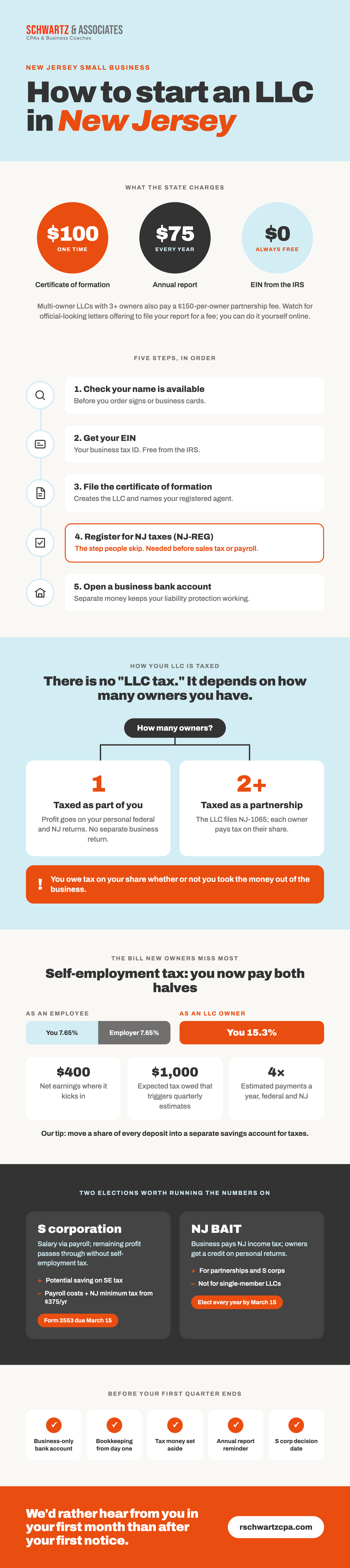
Starting an LLC in New Jersey Comes Down to Five Steps
This is the order we’d follow, and it lines up with the state’s own getting registered page:
- Check that the name you want is available on the New Jersey Business Formation portal, before you order signs or business cards.
- Get an Employer Identification Number (EIN), which is your business’s tax ID number. The IRS EIN page says you never have to pay for one, so skip any website that charges a fee.
- File a certificate of formation through the state portal. This is the document that actually creates your LLC, and it names a registered agent, which is just the address where the state sends official mail.
- Register for New Jersey taxes on Form NJ-REG. People skip this one because the LLC already exists by now, but you need it before you can collect sales tax or pay employees.
- Open a business bank account in the LLC’s name and keep your personal spending out of it.
That last step matters more than it sounds, because keeping business and personal money apart is part of what keeps the LLC’s liability protection working.
We’ve written more about why owners shouldn’t mix personal and business funds if you’d like the longer version.
What Does It Cost to Start an LLC in New Jersey?
For most single-owner LLCs, the state’s part of the bill is small. It’s $100 to file your certificate of formation and $75 a year for the annual report that keeps the LLC in good standing, according to the New Jersey registry fee schedule, and the EIN is free. If you’ve seen a higher formation fee in an older article, go with the state’s current schedule.
A few other costs depend on your business:
- If your LLC has more than two owners and earns money in New Jersey, the state charges a partnership filing fee of $150 for each owner, according to the Division of Taxation.
- Your town may require local licenses or permits, depending on the kind of work you do.
- If you’d rather not list your own address as the registered agent, you can pay a service to do it for you.
Keep an eye on your mailbox once the LLC is on file, because you’ll probably get official-looking letters offering to file your annual report for a fee.
The Division of Revenue warns owners about these letters, and you can file the report yourself online.
How Your LLC Is Taxed Depends on How Many Owners It Has
Neither the IRS nor New Jersey taxes an LLC as an LLC. Instead, they treat it like something else, based on how many owners it has and whether you’ve made any elections.
If you’re the only owner, the IRS treats the LLC as part of you, and the profit goes straight onto your personal tax return, as the IRS explains on its LLC page. New Jersey does the same, so a single-owner LLC doesn’t file its own business income tax return, and the profit shows up on your personal New Jersey return instead, according to the state’s Starting a Business guide.
If you have two or more owners, the LLC is treated as a partnership. It files a partnership return with New Jersey, the NJ-1065, but it usually doesn’t pay income tax itself, because each owner pays tax on their own share of the profit.
What surprises people is that you owe tax on your share whether or not you actually took the money out. If the LLC makes a profit and you leave it in the bank to buy a truck next year, the tax on that profit is still due this year.
An LLC can also choose to be taxed as a corporation, and we’ll come back to that choice in a minute. First, though, there’s one tax that applies to almost every new owner.
Self-Employment Tax Is the Bill New LLC Owners Miss Most
When you worked for someone else, your employer paid half of your Social Security and Medicare taxes and took the other half out of your paycheck. Now that you own the business you pay both halves yourself, and that’s what self-employment tax is.
The self-employment tax rate is 15.3%, covering both Social Security and Medicare. It kicks in once your net earnings from the business reach $400 for the year, and you pay it on top of your regular federal and New Jersey income tax.
Since nothing gets withheld for you anymore, the IRS expects you to pay as you go. If you expect to owe $1,000 or more when you file, you generally need to make quarterly estimated tax payments, and New Jersey has its own estimated payments as well.
The owners who get caught by this usually aren’t careless; they’re just busy, and the money sitting in the account looks like profit when part of it really belongs to the IRS. We tell new owners to move a share of every deposit into a separate savings account for taxes so April isn’t a scramble, and it’s one of the things our bookkeeping service keeps an eye on month to month.
When Should Your LLC Elect S Corporation Status?
Once your profit is steady, you’ll probably hear someone say you should “elect S corp.” That’s a tax choice, so your LLC stays an LLC and the IRS simply taxes it a different way.
As an S corporation, you pay yourself a reasonable salary through payroll, and the rest of the profit passes through to your personal return without self-employment tax on it. That difference is where any savings would come from.
It isn’t automatically a win, though. You’ll pay to run payroll, and New Jersey charges S corporations a minimum tax that starts at $375 a year, which a regular single-owner LLC doesn’t pay. That’s why we run the numbers on your actual profit before we recommend it.
Timing matters too. Form 2553, the form that makes the election, has to be filed within 2 months and 15 days after the start of the tax year you want it to cover, or any time during the year before, according to the IRS instructions. For a calendar-year business that wants the election for 2027, that means by March 15, 2027. If you’re also weighing the bigger structure question, our post comparing S corps and C corps goes deeper.
New Jersey’s BAIT Election Only Fits Some LLCs
New Jersey also has something called the Pass-Through Business Alternative Income Tax, or BAIT for short. It lets the business pay New Jersey income tax itself, and then the owners get a credit for that tax on their personal New Jersey returns.
According to the Division of Taxation’s BAIT page, LLCs taxed as a partnership or an S corporation can choose it if at least one owner is a person, estate or trust that pays New Jersey income tax. The same page lists single-member LLCs and sole proprietors as not eligible, so for most new owners it only comes up once there’s more than one owner.
If it does apply to you, the election has to be made again every year because it doesn’t carry over, and it’s due by March 15 of the following year for a calendar-year business. Whether it’s worth doing is a planning question, so we’d talk it through in the same conversation as the S election.
What Should You Set Up in Your LLC’s First Few Months?
The first few months are when small setup choices save you the most cleanup later.
Before your first quarter ends, we’d want to see these in place:
- A business bank account and card that you only use for the LLC
- Bookkeeping that starts with your very first deposit, so nobody is rebuilding the year in March
- A habit of setting money aside for federal and New Jersey estimated taxes
- A calendar reminder for your annual report
- A date to decide on the S corporation election, with your real numbers in front of you
For the planning side of launching, like your business plan and financing, our guide to starting a business covers it.
Start Your New Jersey LLC With the Taxes Already Planned
Forming an LLC in New Jersey takes a few filings and a $100 state fee, but running one well takes a tax plan, and the best time to make it is before the first profit comes in.
That’s the work we like most. We’d rather hear from you in your first month than after your first notice, and we’re excited when clients call us. If you’re setting up a new LLC, or you set one up and aren’t sure it’s taxed the right way, our New Jersey tax services start with exactly that conversation.
If you’re still deciding between structures, our post on whether your business is structured to maximize your tax position is a good next read.
And when you’re ready, reach out to the team at Schwartz & Associates. We’re responsive, honest and real, and we’ll help you set it up right.
Until next time.